Google’s experts have published a threat report on the Android ecosystem for 2018. It turns out that the number of malware on Google Play continues to grow and has nearly doubled over the course of the year. However, the experts claim there is nothing to worry about.
The fact is that the main reason for the increase in malware is “potentially dangerous applications,” which now include adware. Previously, these applications that abuse advertising were considered to only violate catalog rules. They are now considered full-fledged malware and “spoil the statistics”: in 2017, there were only 0.04%, and in 2018, they were already at 0.2%.
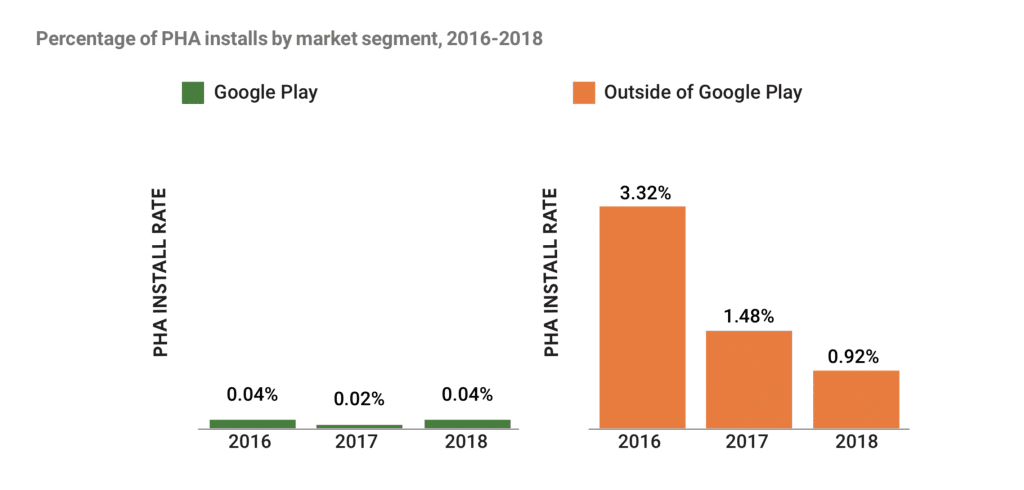
At the same time, if you exclude click fraud from the collected statistics, the number of installations of potentially dangerous applications from Google Play for the year decreased by 31%. Most often, the victims of such applications are users in the United States, Brazil, and Mexico.
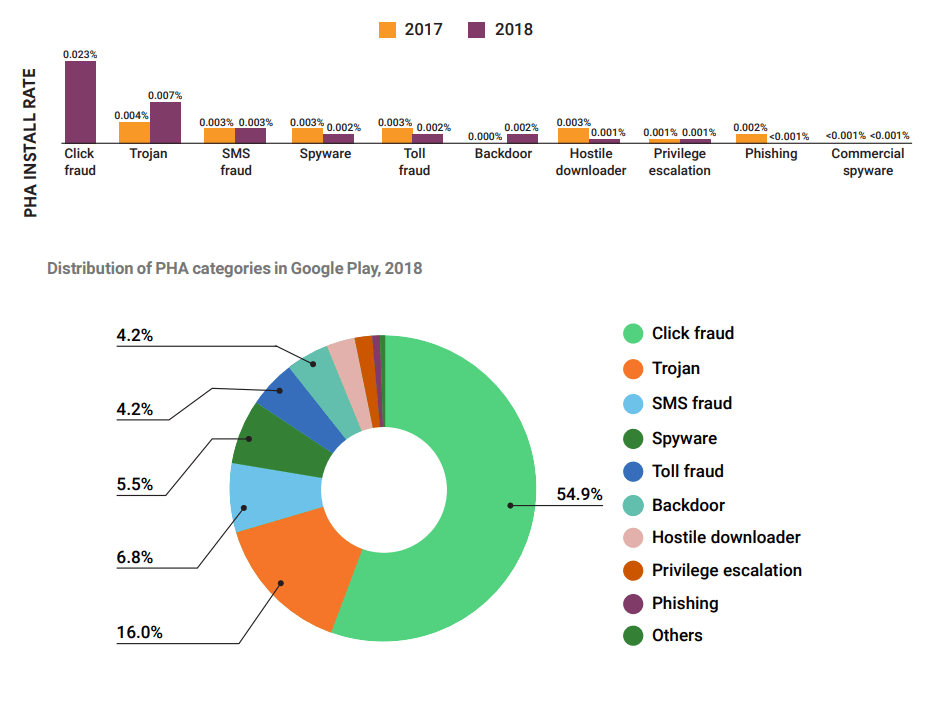
According to the report, adware currently accounts for 55% of all potentially dangerous programs in Google’s official directory. The second spot in the “classification” of adware malware is occupied by Trojans, which reached only 16%.
But outside Google’s official Play Store catalog, according to the company, the situation is much worse. Thus, over the year, Play Protect prevented the installation of 1.6 billion potentially dangerous applications, and 73% of them did not come from Google Play.
Also outside Google Play, the list of current threats is slightly different: applications with backdoors (28%) and Trojans (25%) come out on top, and adware accounts for only 13% of the total number of malicious programs. Backdoor applications are most often detected on the devices of users in Russia, Brazil, Mexico, and Vietnam.
It should be noted that researchers link backdoor infections to the Chamois application, which some manufacturers often preinstall on their devices and which, in turn, loads other malware onto the system.