Google has marked a historic turning point in quantum computing. The company unveiled Quantum Echoes, a groundbreaking algorithm capable of solving complex problems 13,000 times faster than the world’s most powerful supercomputers. For the first time, the quantum computer is moving beyond theory to deliver concrete practical applications in medicine, chemistry, and materials science.
Quantum Echoes: what is this groundbreaking algorithm?
The Quantum Echoes algorithm represents a major breakthrough in the field of quantum computing. Published in the prestigious journal Nature, this algorithm, developed by Google Quantum AI, is the first in the world to demonstrate a verifiable quantum advantage. Unlike Google’s earlier demonstrations in 2019, which solved purely theoretical problems, Quantum Echoes paves the way for real-world uses that are transforming scientific research.
The principle relies on out-of-time-order correlators (OTOCs), a sophisticated physical concept that measures how a disturbance propagates through a quantum system. Hartmut Neven, director of Google Quantum AI, compares this technique to an ultra-precise sonar: where a conventional sonar simply detects a wreck on the ocean floor, Quantum Echoes can read the identification plate attached to its hull.
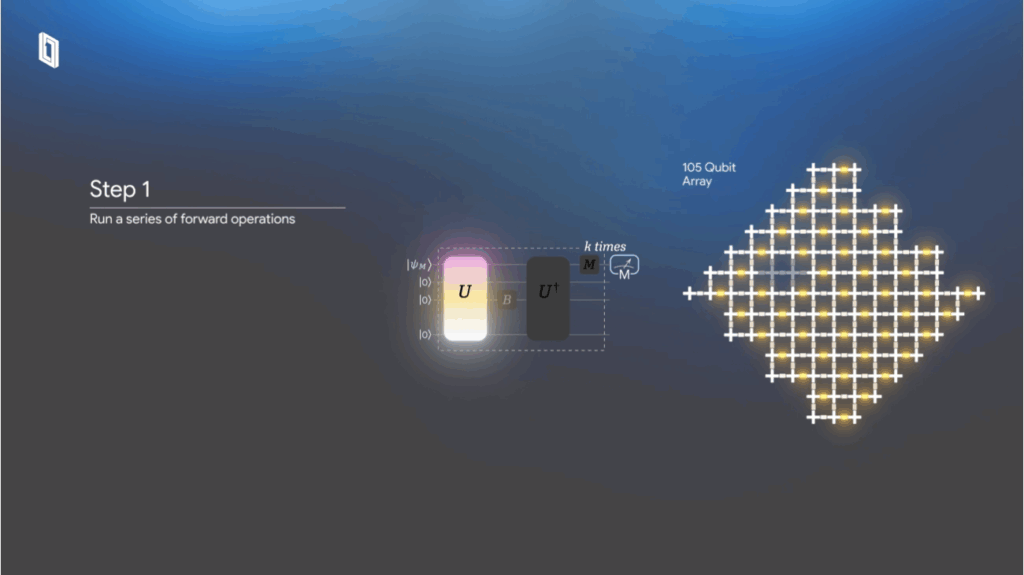
The algorithm works in three precise steps. First, researchers send a specific signal into the quantum system of the chip. Next, they deliberately disturb a single qubit, acting as a “quantum butterfly.” Then they reverse the evolution of the system, as if rewinding a video, and “listen” to the resulting quantum echo. This echo reveals, with unmatched precision, how the disturbance spread across the entire processor.
Performance that shatters records
The results of Quantum Echoes are spectacular. The algorithm solved in a matter of hours a problem that would have required about 3.2 years of computation on Frontier, the most powerful supercomputer currently in operation. This 13,000-fold speedup marks a major qualitative leap in the computing capabilities available for scientific research.
The algorithm runs on the Willow chip, developed by Google and announced in December 2024. This chip, equipped with 105 superconducting qubits, delivers exceptional technical performance: a fidelity of 99.97% for single-qubit gates, 99.88% for two-qubit gates, and 99.5% for readout. These remarkable precision rates allowed the team to carry out a trillion measurements during the Quantum Echoes project.
During a press conference, Hartmut Neven stressed that “this is the first time in history that a quantum computer has run a verifiable algorithm that surpasses the capabilities of supercomputers.” This verifiability is a fundamental difference from previous announcements: the results can be reproduced on other quantum platforms and validated by real physical experiments.
Concrete applications: from chemistry to medicine
The most promising aspect of Quantum Echoes lies in its immediate practical applications. Google has shown that the algorithm can revolutionize nuclear magnetic resonance (NMR), a fundamental technique used to determine the structure of molecules in chemistry and biology.
In collaboration with the University of California, Berkeley, the researchers tested Quantum Echoes on two real molecules containing 15 and 28 atoms. The results revealed structural information impossible to obtain with classical methods. Tom O’Brien, a member of the Google Quantum AI team, explains: “We are building a longer molecular ruler,” making it possible to measure distances between distant atoms beyond current limits.
The technique simulates the “spins” of atomic nuclei using qubits. These spins act like tiny magnets whose magnetic interactions reveal the molecular structure. Quantum Echoes can extract long-range interactions to provide more structural information than is possible with NMR alone.
The identified application areas include:
- New drug discovery: precise modeling of complex chemical reactions and molecular interactions to accelerate pharmaceutical development
- Personalized medicine: deep understanding of disease mechanisms and the ability to diagnose early based on molecular analysis
- Materials science: design of innovative materials with specific properties for industry, electronics and energy
- Advanced batteries: improvement of energy storage technologies through a detailed understanding of electrochemical processes
- Clean energy: development of solutions for fusion energy and other sustainable energy technologies
Ashok Ajoy, a chemist at Berkeley and collaborator on the project, emphasizes: “This illustrates the power of a quantum computer. It’s still the beginning, but the prospects are exciting”. Google anticipates that within five years, real-world applications impossible on classical computers will be operational.
A verifiable quantum advantage: a world first
What fundamentally distinguishes this announcement from previous claims of “quantum supremacy” is its verifiable and reproducible nature. This verifiability rests on two essential pillars that guarantee the reliability of the results obtained.
First, the reproducibility on other quantum platforms : the calculations performed by Quantum Echoes can be confirmed by running the same algorithm on another quantum computer of comparable power. This capacity for independent verification eliminates doubts about the validity of the results and marks a break from earlier demonstrations whose outputs could not be confirmed.
Second, the validation through physical experiments : the predictions of Quantum Echoes can be tested by directly interrogating nature through experiments involving real quantum effects, such as NMR measurements on genuine molecular samples. This grounding in experimental physics gives the results an unquestionable scientific legitimacy.
However, the scientific community maintains methodological caution. Dries Sels, a quantum physicist at New York University, believes that “the burden of proof should be high” and that although the paper does “serious work” by testing various classical algorithms, there is no formal proof that a more efficient classical algorithm does not exist.
James Whitfield, a quantum physicist at Dartmouth College, acknowledges the impressive technical advance but considers it “a bit of an exaggeration to think that this will suddenly solve an economically viable problem”. These reservations reflect the healthy skepticism of the scientific community in the face of spectacular announcements, while recognizing the real progress achieved.
The Willow chip: the technological engine of the revolution
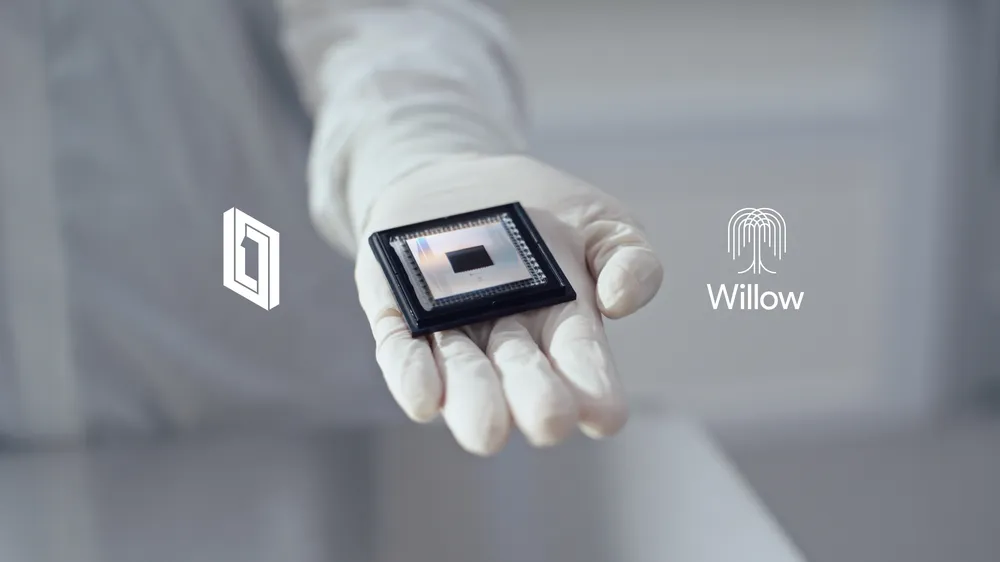
Quantum Echoes could not exist without the Willow chip, the quantum processor developed by Google and announced in December 2024. This chip represents the culmination of years of research in superconducting circuits, a technology whose theoretical foundations earned the 2025 Nobel Prize in Physics for John Clarke, Michel Devoret and John Martinis.
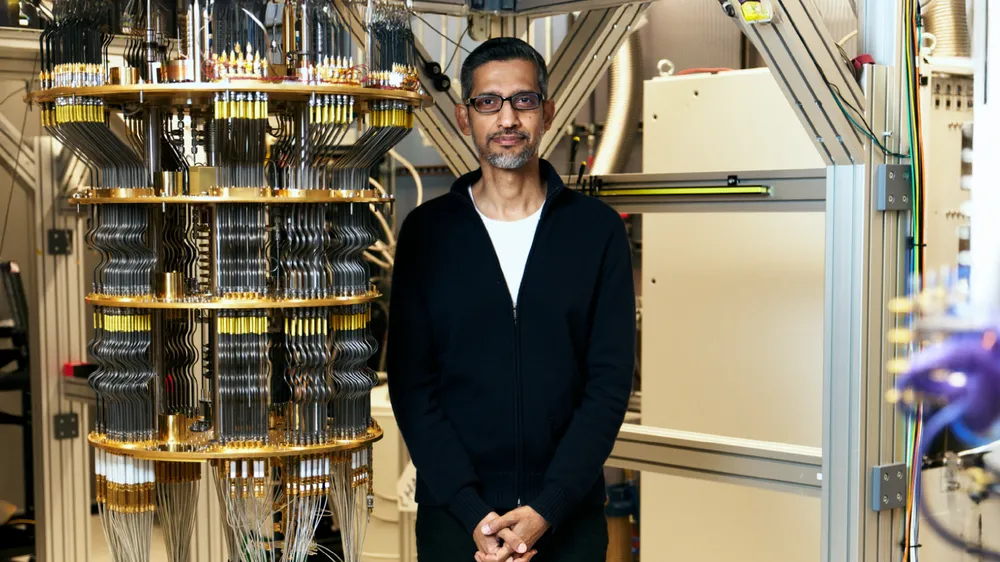
Willow stands out with its 105 superconducting qubits operating at temperatures close to absolute zero (about -273°C). These qubits function as macroscopic “artificial atoms” capable of maintaining quantum superposition states for long enough to carry out complex calculations.
Quantum computer setup with superconducting qubits cooled by a dilution refrigerator for ultra-low temperature operation
Willow’s technical performance is exceptional. The T1 coherence time, which measures how long qubits can retain a quantum excitation, approaches 100 microseconds. This increased stability, combined with operation speeds on the order of tens to hundreds of nanoseconds, makes it possible to run sophisticated algorithms requiring many successive operations without excessive error accumulation.
A crucial aspect of Willow concerns its progress in quantum error correction. Google demonstrated an exponential reduction in the error rate as the size of the qubit arrays increased, scaling from 3×3 to 7×7 grids and halving the error at each step. This achievement, known as “below threshold” performance, represents a major challenge that scientists had been trying to solve since Peter Shor introduced quantum error correction in 1995.
The global competition intensifies
Google is not alone in this strategic technology race. IBM is pursuing its own development with an ambitious roadmap extending to 2033. In June 2025, the company published a framework detailing its path to a fault-tolerant quantum computer by 2029. IBM firmly believes that the first demonstrations of quantum advantage on its platforms will occur by the end of 2026.
IBM is currently developing processors such as the Nighthawk (120 qubits) and the Heron (156 qubits), the latter powering the first IBM Quantum System Two deployed in Europe, in San Sebastián, Spain. The company aims for more than 4,000 qubits by 2025 with its modular architecture, focusing on improving circuit quality to execute 5,000 gates with parametric circuits.
Microsoft, Amazon and Intel are also actively taking part in this competition. Innovative French companies are bringing promising alternative approaches. Alice & Bob raised 100 million euros in January 2025 for its “cat qubit” technology, which naturally suppresses bit-flip errors, one of the two main types of quantum errors. Quandela develops photonic qubits, while Pasqal explores neutral atoms and C12 Quantum Electronics works on spin qubits in carbon nanotubes.
China is investing heavily, with more than 15.2 billion dollars in quantum research, underscoring the geopolitical and digital sovereignty stakes. This intense international competition is turning quantum computing into a strategic priority for the world’s major technology powers.
The Technical Challenges That Persist
Despite this spectacular breakthrough, several major obstacles remain before quantum computers become practical tools on a large scale. Applying Quantum Echoes to more complex molecular systems will require even less noisy hardware or more advanced error correction methods.
The stability of qubits remains a fundamental challenge. Qubits require extremely low temperatures, close to absolute zero, to operate properly. Any thermal fluctuation can introduce errors into the system and compromise calculations. This requirement makes quantum computers complex and expensive to operate.
The scalability constitutes another significant obstacle. Increasing the number of qubits while maintaining quantum coherence and connectivity between qubits represents a considerable engineering challenge. Experts estimate that one million qubits will be needed to perform truly useful calculations across all fields, whereas today’s most advanced machines reach a few thousand qubits at most.
Quantum error correction also comes at a high cost: a single logical qubit requires between 100 and 10,000 physical qubits, depending on the technology used. Moreover, as pointed out in a correction published in February 2025, Willow only implements quantum memory correction and not yet full correction of the logical gates needed to achieve exponential speedup across all types of quantum computing.
The development of specific quantum algorithms for each application domain remains an open challenge. Quantum computing is not meant to replace conventional computers for all tasks, but rather to deliver different algorithms that are unsuited to traditional binary computing.
Impact on Artificial Intelligence and Cybersecurity
Advances in quantum computing have profound repercussions on two critical technology fields. For artificial intelligence, quantum computers could considerably speed up the training of complex models and open new possibilities in machine learning.
Google hopes that Quantum Echoes will be able to generate new, unique quantum datasets, particularly useful in fields such as life sciences, where high-quality data for training AI models is scarce. This ability to create verifiable quantum data could transform the way we develop the most advanced AI systems, particularly for molecular simulation and drug discovery.
Regarding cybersecurity, these advances raise serious concerns for current encryption systems. “Q-Day”, the dreaded moment when a quantum computer will be able to break traditional asymmetric algorithms such as RSA and ECC using Shor’s algorithm, is no longer a purely theoretical scenario but is becoming a concrete strategic concern.
In 2024, institutions such as the NSA, ANSSI and NIST intensified their recommendations to switch to post-quantum cryptography solutions. NIST notably selected several cryptographic standards considered resistant to quantum attacks, laying the foundations for a new security framework for the quantum era. This transition to quantum-resistant encryption protocols represents a major challenge for global digital infrastructure.
Google’s roadmap to 2029
The announcement of Quantum Echoes is part of the ambitious roadmap of Google Quantum AI that charts a path to a fault-tolerant, fully operational quantum computer by 2029. This roadmap comprises six major milestones spread across two parallel and complementary tracks.
The hardware track focuses on building logically reliable qubits and progressively scaling up quantum machines. Google has already reached two important milestones: the demonstration of quantum supremacy in 2019 with its Sycamore processor, and recent advances in quantum error correction with Willow.
The software track seeks to develop algorithms offering a measurable and clear advantage in real-world contexts. The announcement of Quantum Echoes marks Google’s first major victory on this track, demonstrating the first algorithm with a verifiable quantum advantage applicable to concrete scientific problems.
Hartmut Neven stated that “what you see today is a milestone on the software track”, confirming that Google is progressing simultaneously on both technological fronts. The remaining four milestones of the roadmap will combine continuous hardware improvements with the development of ever more powerful and practical algorithms.
2025: The Turning Point for Quantum
2025 appears as a decisive year for quantum computing. We are witnessing a fundamental transition: the shift from fundamental research in the laboratory toward practical experiments in real-world settings. This evolution helps companies and research institutions better understand the concrete uses of this revolutionary technology.
Sectors that rely on high-performance computing are beginning to integrate quantum systems into their existing infrastructure. Finance is exploring applications in portfolio optimization and risk assessment. Logistics is testing quantum algorithms to solve supply chain optimization problems. Chemistry and pharmaceuticals are investing in quantum molecular simulation to accelerate the discovery of new compounds.
Aneesh Raghavan, professor at UCLA, aptly sums up the importance of this period: “This is an important technological breakthrough. We have heard a lot about hardware advances in the field, and for a while I was concerned that the algorithms were not keeping up. But they have shown that this is not the case”.
This convergence between hardware progress and algorithmic development marks a psychological and technological turning point. Quantum computing is gradually moving beyond the status of a futuristic promise to become an emerging technological reality with tangible applications in the short and medium term.
Conclusion: A Revolution in Motion
The announcement of Google’s Quantum Echoes undeniably represents a historic milestone in the development of practical quantum computing. For the first time, a quantum algorithm demonstrates not only a massive speed advantage over the most powerful classical supercomputers, but also offers a clear and verifiable path toward concrete scientific and industrial applications.
The path to a fully operational, fault-tolerant quantum computer remains long and strewn with complex technical challenges. As Google’s researchers have pointed out, reaching their ultimate goal will require improvements of several orders of magnitude in system performance and scale, with millions of components to be developed and matured.
Nevertheless, with Quantum Echoes, we have crossed a crucial psychological and technological threshold. We are moving from impressive theoretical demonstrations with no practical utility to potential tangible applications that could, within the next five to ten years, transform our ability to solve some of the most complex problems facing humanity.
The discovery of life-saving new drugs, the design of revolutionary materials, the development of clean energy, and a deeper understanding of the molecular mechanisms of life are no longer distant promises. With Quantum Echoes, Google has just demonstrated that the era of practical quantum computing has begun.
Stay informed about the latest advances in quantum computing and discover how this technological revolution could transform your industry. Follow our in-depth analyses and exclusive news on emerging technologies.