The United States now bans the import of foreign robots following a radical decision by the Federal Communications Commission (FCC). Indeed, American authorities fear the use of these devices and solar inverters for surveillance. They also fear remote control and attacks on critical infrastructure. Thus, the FCC has recently added this equipment to its blacklist. As a result, companies can no longer certify, sell, or market these devices on American soil. Officially, this measure does not target any specific country. However, it will mainly hit China, which currently dominates the global humanoid robot market.
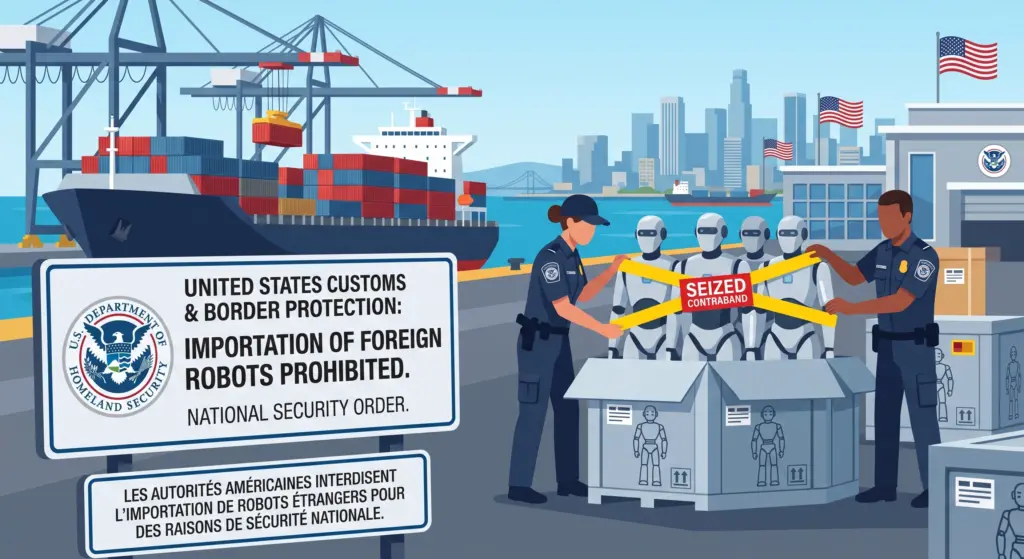
Which foreign robots are affected by this ban?
These new restrictions go far beyond humanoid models or robot dogs. In reality, the FCC’s definition is very broad. It encompasses any mobile ground device weighing more than 2 kg. Moreover, the machine must be able to move or avoid obstacles. It must also have sensors and communication systems. Finally, it must use software for navigation or data collection. The legislation nonetheless provides for exceptions. Automobiles, trains, and drones escape this rule. Underwater vehicles, medical equipment, and fixed industrial arms also remain authorized.
Major Concerns for National Security
Last year, consumers bought about 15,000 humanoid robots worldwide. Two Chinese manufacturers dominate this sector, moreover. Meanwhile, inverters are much more common. Installers use them to connect solar panels to the electrical grid. Consequently, the United States sees a great danger in these foreign robots and connected equipment. Authorities believe that covert remote access would open the door to serious abuses. Hostile states could easily collect sensitive data. They could also disable equipment or coordinate massive cyberattacks.
Documented Security Flaws
To justify this ban on foreign robots, the FCC relies on several serious studies. The regulator notably cites the UniPwn flaw. This breach gave full access to Unitree robots (Go2, B2, G1, H1). It then allowed infecting nearby devices via Bluetooth. The document also mentions another critical vulnerability. This one enabled remote control of Unitree Go1 robot dogs via the CloudSail cloud.
The Worrying Case of Solar Inverters
Regarding inverters, the FCC highlights the SUN:DOWN study by Forescout. The researchers discovered 46 flaws in products from Sungrow, SMA, and Growatt. They concluded that a hacker could control several units at the same time. Such an attack would seriously destabilize the electrical grid. Moreover, the report describes an alarming incident. A foreign manufacturer has already remotely shut down its inverters after a dispute with an American distributor.
What Future for Foreign Robots Already Sold?
Fortunately, this new law does not affect devices already approved. Retailers can still sell these older models in the United States. The FCC also expressly authorizes the deployment of patches and updates. This tolerance will last at least until January 1, 2029. Furthermore, manufacturers can request temporary approval until January 1, 2028. In conclusion, the FCC insists on the preventive aspect of this move. The goal is to secure the national supply chain. Unsurprisingly, Beijing has strongly criticized this decision. The Chinese government promises to take all necessary measures to defend its companies.